Episode 2: Tucson
David takes us on a back-alley tour of Tucson’s public art and shows us one of the best Sonoran hot dogs you’ll ever eat.
Listen to City Share wherever you get your podcasts.



David: 00:07
I feel like the Coyote’s just always been like a part of my life. And then, you know, living in the desert, I mean they’re they’re everywhere. You hear them everywhere. They they navigate through the washes, through the alleys, you know. Kind of the same way I navigate the city. I’m like all over the place, you know.
Sam: 00:24
I can’t help but conjure an image of riding bikes through alleyways and stuff. And I don’t know, is there a relationship there too?
David: 00:33
Yeah, there’s a lot of little like shortcuts I put into the ride today. So
Sam: 00:44
This is City Share, a show about how we move through cities and how cities move us. I’m Sam Herr. Today, Tucson. I actually grew up in Tucson, so in a lot of ways, I know the city really well. There are trails out here that I used to ride as a kid all the way to the end. To the point where they merged into the desert. But I haven’t lived here in over 20 years, and things have changed a lot. Those trails don’t just end anymore, they keep going. So I recruited a tried and true Tucson native to show me what the city is like now and how it’s changed.
David: 01:26
Yes, I grew up here in Tucson. I’ve been here for 39 years.
Sam: 01:36
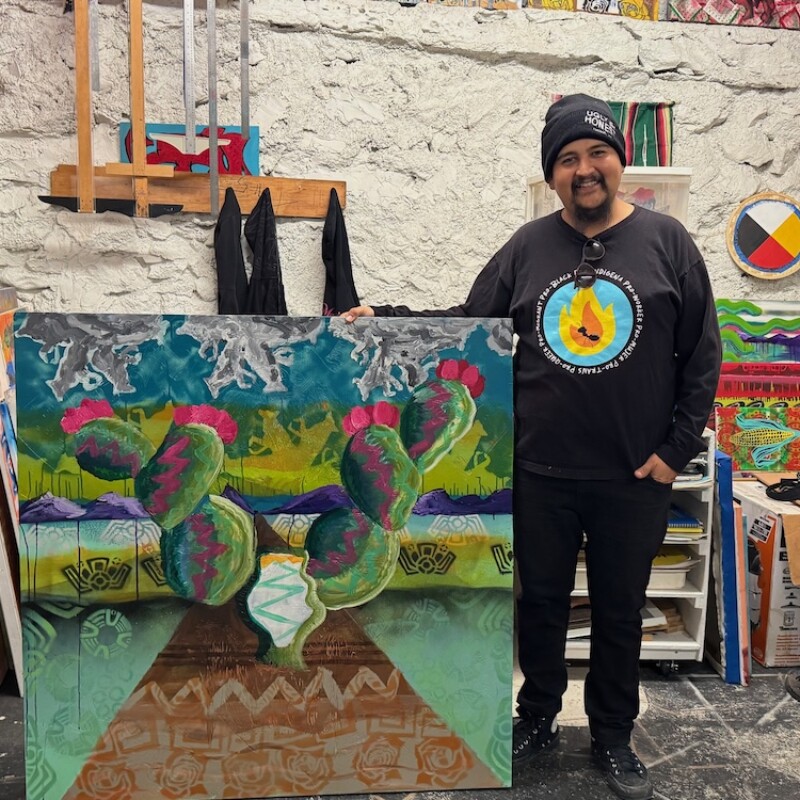
I meet our guide David at his art studio in downtown Tucson called Tool Shed.
David: 01:41
This is the studio.
Sam: 01:42
Wow, it’s awesome. It feels very creative in here, very like bursting with ideas.
Sam: 01:47
He’s a painter, printmaker, and art teacher.
David: 01:56
Um just the only sketchy part.
Sam: 01:59
We walk down some steep metal stairs, like almost a ladder…
David: 02:04
I usually run down these
Sam: 02:07
into a big concrete basement and there’s artwork everywhere.
David: 02:11
I’ve been going through and like recycling or also painting over things, so it’s kind of been part of the process is just sometimes eliminating something and just starting over again.
Sam: 02:21
Interspersed with all these different layers of paintings or bikes, including this one bike. Oh, that’s the bike that you crashed on.
David: 02:30
Yeah.
Sam: 02:30
Or you got actually I want to ask you about that. I don’t know if you want to dive in now or you want to.
Sam: 02:35
About a year and a half ago, David was riding his bike home from work along Valencia, a major road in Tucson.
David: 02:41
Valencia was my main, you know, my main road, and you know, a lot of people thought I was crazy for riding on Valencia, but you know, for uh just all the accidents that have happened, you know, it’s a really fast-moving street.
Sam: 02:54
The bike lane on Valencia ends at a freeway on ramp, which means that bikes have to merge into busy traffic to cross the intersection.
David: 03:02
You know, and so I just remember crossing the dotted line and then out of nowhere, I just remember being thrown in the air, slamming the ground, and just being dragged by the car for a little bit. And then when the car finally stopped, I was just kind of like face down, I was face down, trying to kind of like get myself up, and I was like, oh man, I just got hit by a car.
Sam: 03:26
David took a break from biking for a while, not only to recover physically, but also to recover from the trauma of the whole experience. But he’s been slowly making his way back to biking.
David: 03:39
But you know, I feel like I’ve been finding more joy in like riding again, and there’s like so much positivity you get out of a bike. You know, you can ride as far as you want or as far as your body lets you, and sometimes you even push past that. I gotta go back to that feeling, you know. I want to go ride bikes, I wanna go ride bikes.
Sam: 04:00
David’s not quite riding like he used to, though.
David: 04:03
But I feel like, you know, I’m I’m just glad that I can still ride a bike. Um, but it’s definitely changed my mentality of like where I ride and how I ride. I feel like now I navigate more of those back areas, those bike paths, bike boulevards, and that’s where you know I find more comfort because I’m not as worried about you know cars speeding by.
Sam: 04:26
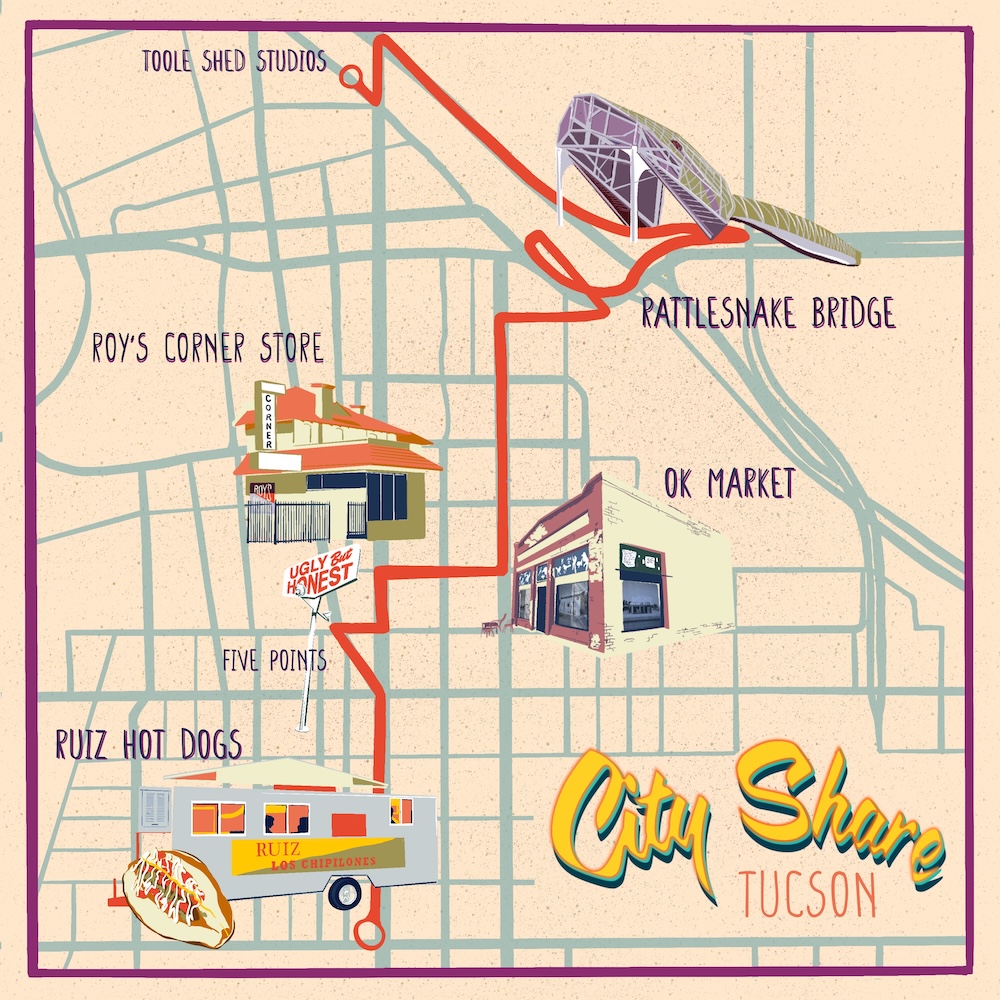
Today, David is taking us on a new bike path in downtown Tucson through the back alleys of the historic district, and then we’ll end at one of the city’s Sonoran hot dog carts. We head from the studio to a two go station across the street. We grab our bikes and get on our way. We’re biking along Aviation Bikeway, a protected bike path running along Barraza Parkway, one of Tucson’s main roads downtown. I’ve gotta say, things look a lot different around here than I remember.
David: 05:04
It’s just funny because I remember, you know, in my younger days coming here to Maloney’s, and like now that’s no longer, you know, their.
Sam: 05:13
Maloney’s Tavern was a Tucson institution.
Sam: 05:16
So I as well remember Maloney’s, the Greyhound. Now it’s like this housing complex uh with the um the trolley station. I was like, oh my god, this is where Maloney’s was, and that was where the Greyhound was. I can’t even recognize it. Yeah.
Sam: 05:32
The original Maloney’s was torn down in 2019 to make room for a new housing development. And that’s just kind of downtown Tucson these days. Basically, a whole new city popping up. Eventually, the path opens up into a nice park. There’s red dirt and scrubby desert plants all around us. We round a corner to Rattlesnake Bridge, which is this giant bike and pedestrian bridge shaped like a rattlesnake. You have to ride through the open mouth of the snake and then through its body to cross the highway.
David: 06:11
I had heard rumors that at one point it used to make rattling noises at the other end, but I don’t yeah, I haven’t found the source of if that was true or not.
Sam: 06:22
We check out the bridge and then we double back the way we came and exit the trail onto some small neighborhood streets. And where are we headed?
David: 06:30
Uh we’re gonna then head into uh some of the older neighborhoods that are right here off to the side. Um I love the stucco architecture.
Sam: 06:42
We stop at a closed-down corner store on the corner of 16th Street and 4th Avenue. It looks pretty old, it’s all boarded up, but outside there’s some chairs and a table for people to just stop and sit.
Sam: 06:55
So this was a grocery store, but now it became sort of like an art installation building.
David: 07:04
Yeah, it’s kinda like a little art installation. So they’re still trying to, I guess, keep the integrity of it.
Sam: 07:04
There’s black and white photos of the old grocery store wheat pasted over the shop’s boarded up windows, and some writing overhead. And it’s also got um bilingual, like it’s written in both.
Sam: 07:15
It says, I remember well back in the 1970s when this was a store owned by some Chinese people.
David: 07:36
Recuerdo bien cuando, allá por los años 70, esta tienda era propiedad de unos chinos…
Sam: 07:36
and I loved to come in for the smell of the candy that was always inside the store.
David: 07:36
Me encantaba entrar por el olor a dulces que siempre había dentro de la tienda.
Sam: 07:36
I walked here when I was a child.
Sam: 07:37
Sam: 07:37
Yeah, that’s amazing.
Sam: 07:41
The American Gold Rush brought Chinese immigrants to Tucson. By the nineteen forties, there were over one hundred Chinese grocery stores that also offered services in Spanish, English, and indigenous languages. They even blended Chinese and Mexican ingredients to create new foods like Chinese chorizo, which has now generally disappeared along with these neighborhood markets, like this one, which closed in 1977. It remains on the corner though, preserved by the community to honor a little piece of Tucson’s history.
Sam: 08:12
Yeah, this is cool. I mean, you don’t see a lot of places that are sitting vacant kind of repurposed in this intentional way.
David: 08:20
Yeah, so there’s people out there still taking that history while there’s elders around and you know, capturing that history and preserving that history so that we remember,
Sam: 08:44
We hop on the bikes and head down Fourth Avenue to Roy’s Corner Store, a modern market still in operation.
Sam: 08:51
Sam: 08:55
We head inside for Tapache sodas. Tapache is a delicious fermented pineapple drink traditional to Mexico. Many people like David’s dad make it at home, but there’s also a canned kind.
David: 09:11
Different flavors. They got mongo chili, grapefruit, prickly pear, watermelon, and then the pineapple spices like the original.
Sam: 09:19
Even though I’m a little bit of a wimp about spice, I go for the original. It’s delicious.
David: 09:24
Up on the bike. Cool.
Sam: 09:27
After a short break, we get moving again. We turn onto Sixth Avenue and ride down a few blocks to Five Points, a big star-shaped intersection where five roads and five neighborhoods meet.
Sam: 09:39
Oh wow, with a big sign that says Barrio Viejo.
Sam: 09:42
The streets all have huge steel arches over them with each barrio’s name on it. We cross under Armory Park, where we just came from, towards Barrio Viejo, where we’re headed next.
Sam: 09:55
Oh, I think I’m remembering this corner now. Yeah. I did notice earlier you were wearing an ugly but honest hat. And I was holding and asking questions because I knew we were gonna come by and I see the sign over there.
Sam: 10:08
Across the street is a sign poking up over the buildings with bold red lettering ugly but honest.
David: 10:16
So ugly but honest was a dealership where they would sell cars that were ugly but honest pricing. So and then out of nowhere, you know, later on, this actually became uh actual business.
Sam: 10:29
Now the dealership is a hip pizza spot by the same name. A white stucco building sits where the old dirt lot used to be. But the sign? It’s still there. A bit of history blending in with all the new. We continue through Five Points to our last stop at Ruiz Hot Dogs. You can head straight down Sixth Avenue if you want a straight shot, but David winds us through some back alleys to check out some murals and architecture.
Sam: 10:57
Yeah, definitely a lot of old with new architecture around here.
David: 11:00
Like this one, they revitalized this building.
Sam: 11:00
Sam: 11:02
We come up to a big dirt lot at the corner of 22nd Street, and I see what looks like a glorified food truck sitting by the road. It’s got the food truck part, and then kind of a large metal movable restaurant structure on wheels. We roll up and park our bikes.
Sam: 11:19
Oh my god, it smells amazing. Oh my gosh, it’s like sweet, and it’s kind of like a food truck, but uh but like more. Awesome.
Sam: 11:31
Tucson is famous for the Sonoran hot dog. There are hundreds of daguerros around town serving them out of food trucks and carts. A Sonoran dog is grilled, wrapped in bacon, and served in a squishy, slightly sweet bun, topped with pinto beans, tomatoes, onions, mustard, and mayo.
David: 11:49
What I do is I’ll mix jalapeno and guacamole, and then put it on there.
Sam: 11:54
The Sonoran dog comes from the town of Hermosillo, Mexico, not too far away on the other side of the border. No one knows exactly how the hot dog made its way to Hermosillo, but the doguereos there started wrapping their dogs in bacon and toppings. And eventually, the new dog traveled back across the border to Arizona.
David: 12:13
Did you want a hot dog with everything?
Sam: 12:15
Okay, so I’m actually vegetarian. Okay. But I we still want to do this because this is gonna be the interesting force.
Sam: 12:20
Okay. So here’s the thing. I grew up in Tucson, but I’ve never actually had a Sonoran dog because I don’t eat meat. I figured I’d just talk to David while he got a hot dog, but instead, David kind of blew my mind.
David: 12:36
So did you not want the weenie in it, but everything else? Perfect idea.
Sam: 12:40
I have never thought of Sonoran dog, no dog before. Okay. If you eat one thing in Tucson, it’s gotta be a Sonora dog.
Sam: 13:04
Oh my god, this is so good.
Sam: 13:07
It’s something that could only exist in these desert borderlands where change is constant.
David: 13:14
A lot of the places we’ve been, businesses, you know, Roy’s liquor, um, that building that we passed, you know, they’re all revitalizing something, you know, the ugly but honest, you know. They’re taking something that was there and memorializing it, but also making it into something new.
Sam: 13:34
This was a really fun ride. From David’s studio to Ruiz Hot Dogs was just over three miles, or about five kilometers, which could be easily broken up into sections. Just the aviation bike path or just winding through the neighborhoods, or you could make it a loop for something a little longer. We almost never found ourselves on a busy road full of cars, really just bike paths and back streets, so it’s good for any experience level. Big thanks to our guide David for helping me peel back the layers of Tucson and see it through his eyes. Next up, we’re gonna be going to Boston with Grey, who’s going to give us the scoop on the Alston Brighton creative scene.
Grey: 14:19
Your painting and drawing and doodling on anything you have access to
Sam: 14:24
and some of his favorite dessert spots.
Grey: 14:27
The weekend cafe has a craffle, and I’m really into croissants and I’m really into waffles. Those are two of my favorite like bread products, and they’ve combined them for savory and sweet desserts here. So, this is one of my favorite spots to like meet up with people.
Sam: 14:45
City Share is brought to you by the North American Bikeshare and Scootershare Association, and it’s supported by the Better Bike Share Partnership. Huge thanks to them for that support. They do amazing work. Another big thanks to Sun Tiki Studios in Portland, Maine, who donated the studio time and space for us to record this podcast. They are awesome. Special thanks to Sandy Chan and the Chinese Chorizo Project for this episode, who helped us track down the history of OK Market. City Share is reported and produced by me, Sam Herr. I am also the executive producer for the show. Our other producer and fact checker is Ariel Knoebel. Our editor is Peter Lang-Stanton. He also mixed the show. Our show art is by Ariel Knoebel. Music is by Blue Dot Sessions. Sound effects are from Freesound.org. Additional sound effects by mboscolo. And once again, I’m your host, Sam Herr. Thanks for listening.