Episode 5: Omaha
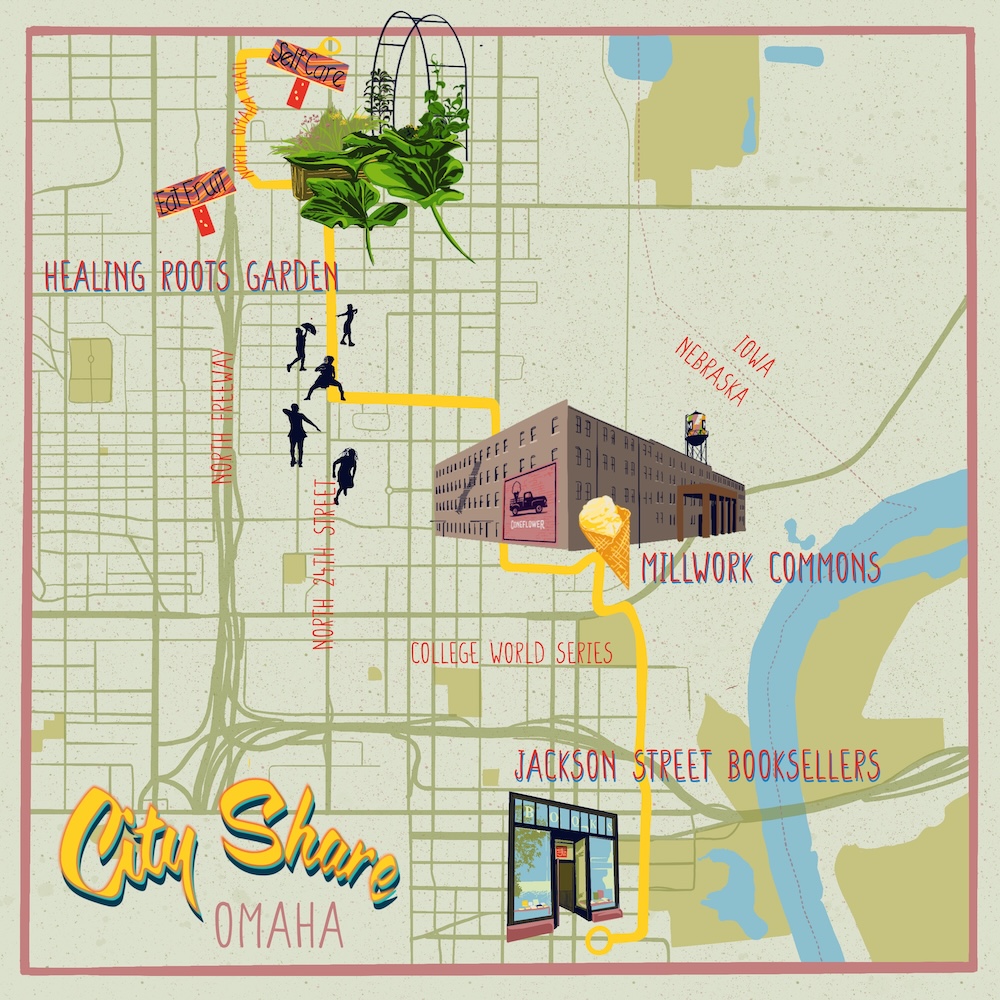
Clarice introduces us to a community garden like no other, small batch artisan ice cream you’ll want to tell all your friends about, and one of the last used bookstores left in the city.
Listen to City Share wherever you get your podcasts.



Sam: 00:04
Okay, hopefully this isn’t offensive to you, but when I told people that I was coming to Nebraska, uh, they were like, You’re going where? Like, why are you going to Nebraska?
Clarice: 00:13
People ask me the same thing all the time. Actually, when I say I’m from Omaha, they’d be like, What’s Omaha? People live there.
Sam: 00:26
This is City Share, a podcast about how we move through cities and how cities move us. I’m Sam Herr. Today, Omaha. Unfortunately, what’s Omaha is a pretty common reaction to this place, which is totally undeserved because it’s full of new public art, street festivals, new bike trails, new construction is everywhere. There’s just so many new ideas going into this place. Unlike New York or LA that feel finished, Omaha definitely feels like a place where you can pitch in and really make your mark. So, yeah, it looks like you had a lot of sunflowers. What else were you growing in this garden?
Clarice: 01:12
So we grow African and American heirloom varieties of produce, old-timey blue-collared greens.
Sam: 01:20
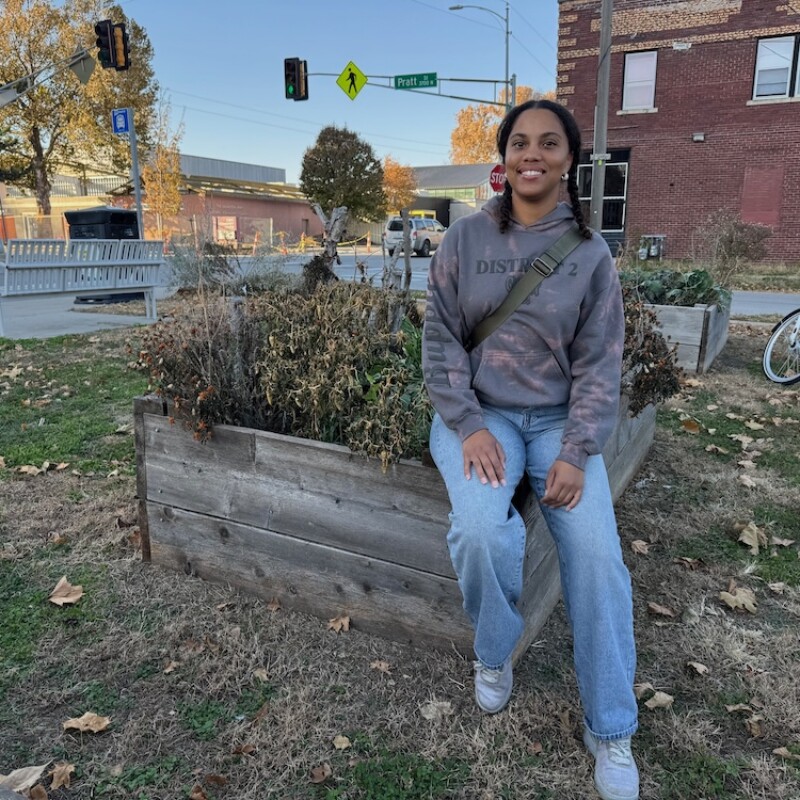
I meet our Omaha guide, Clarice, at a community garden in North Omaha.
Clarice: 01:24
A couple different varieties of mustard greens, kale, a bunch of different tomatoes. It’s small.
Sam: 01:30
About a dozen raised beds on an empty lot.
Clarice: 01:32
A couple different types of squash, normally, just things that people in the neighborhood like to eat.
Sam: 01:37
Clarice started Healing Roots African Diaspora Garden during the pandemic. And it’s a different kind of community garden than I’ve ever come across in a bunch of ways. First of all, it’s for everyone. And I mean everyone. Like anyone walking by can just be like, oh, I want a tomato for dinner, and they just take the tomato.
Clarice: 01:57
Yep, they sure can. And it actually took a very long time to get people used to that because most community gardens are like, this is my bed, this is my bed, this is my bed.
Sam: 02:09
And while most community gardens are tended by a community, Clarice basically does this alone. It’s less of a community garden than Clarice just growing food for people for free. Wow, so impressive. It’s also a lot to take care of.
Clarice: 02:23
It is.
Sam: 02:25
But the community shows up in other ways. The garden is a gathering spot. People stop by to hang out, they sit on the edge of the beds and talk, and every year they throw a festival. The one in 2023 was especially memorable.
Clarice: 02:38
It was really hot out. Everybody was out here just sweating through their clothes. Um, but then the sun went down, and that’s when everybody, you know, got up and had the energy to start dancing.
Sam: 02:54
One of Clarissa’s friends bought a projector and projected the garden’s logo onto the public housing building across the street.
Clarice: 03:01
We were just out here dancing, and then we had the Healing Roots logo behind us, and it was just really a a good time. That’s one of my favorite memories for sure.
Sam: 03:20
Clarice grew up nearby. She thought her old neighborhood should have a garden, and she just did it. That’s not just a Clarice thing. I’ll learn on my ride today, but that seems like an Omaha thing. Cool. Okay, let’s do this. We hop on our bikes. In Omaha it’s called Heartland Bike Share, and get going. Today, Clarice has planned a ride starting at this garden in North Omaha and heading south to downtown to her favorite used bookstore, Jackson Street Booksellers. And on the way, we’re going to stop and get some ice cream at Clarice’s favorite ice cream shop, Cone Flower. Alright. So we’re on the corner of Pratt in 24th, and we’re going down Pratt or down 24th?
Clarice: 04:09
Down Pratt.
Sam: 04:09
Okay. We ride down a neighborhood street. Man, it’s such a beautiful day. At the end of the street, there’s a brand new bike path, the North Omaha Trail.
Clarice: 04:18
I was a part of the team at one point that was developing the trail. It means a lot to me.
Sam: 04:25
Clarice helped bring this trail to life. She hosted a tree planting where they planted 175 trees along the path, and we’re passing them now as we ride. This seems like a peaceful neighborhood.
Clarice: 04:40
It is for sure. There’s lots of families.
Sam: 04:46
The trail runs along the North Freeway, which is over a grassy hill, so you can’t really see it or hear it that much. Before the bike trail was here, this was just a strip of unused land between a neighborhood and the freeway.
Clarice: 05:04
Especially just knowing the history of the North Freeway, and that there used to be a neighborhood here that’s no longer here.
Sam: 05:13
They started building the North Freeway in the 1960s, and they had to demolish over 2,000 homes to build it. 2,000 families had to move somewhere else. A whole community forced to scatter.
Clarice: 05:26
Particularly the Black community in North Omaha, because there was great harm caused by the development of this freeway.
Sam: 05:34
The freeway cut Omaha’s historically Black neighborhood in half. Like took away a neighborhood, basically like a Black neighborhood of North Omaha.
Clarice: 05:41
Yes, yep.
Sam: 05:59
Wow. Oh wait, can I stop and take a photo of that?
Clarice: 06:02
Yeah. Sorry.
Sam: 06:04
All along the trail, there are beautiful hand-painted signs. Nailed to a tree or lying in the grass. Each one is a little affirmation.
Clarice: 06:11
There’s one that says self-care and the other says ecosystem. An Omaha artist and my friend Patty Talbert does these signs.
Sam: 06:20
There’s 120 of them in different spots along the trail. Is there one that has particularly spoken to you in uh a day you needed it?
Clarice: 06:28
I think there’s one that says eat fruit. And it’s like, yeah, I should probably eat some fruits and vegetables right now. Like that’s actually really what I need.
Sam: 06:37
That’s awesome. Alright, I’m gonna snap a photo of this one. Spoken like a true gardener. I met up with Clarice over an hour ago by now, and we’ve gone not even a mile, which is kind of amazing. Clarice is so involved in her city that everywhere we go is layered with meaning. The city isn’t just something that other people build. For her, Omaha streets, buildings, trails, it’s all personal. What would you say some of your favorite things about biking are? And I’ve been biking in Omaha since we’re here.
Clarice: 07:22
Oh goodness, let me think. Just how calm and sort of serene it is. I’ve biked in other places before, and it can be intense.
Sam: 07:50
Well, there’s a mural too on the building. Like a grand finale of the trail we’ve been following the whole way. Now we’re on North 24th Street, which is a whole busy neighborhood for shopping and music and other stuff. Omahaans just call this neighborhood North 24th.
Clarice: 08:09
It’s definitely a busier corridor in North Omaha, busier district. I think the last time I was in the neighborhood was this summer for Native Omaha Days, which is like a weeklong festival that happens down here.
Sam: 08:24
Native Omaha Days happens every other year. There’s a parade, there’s music, there’s food. Wow, that sounds cool. What’s the festival about?
Clarice: 08:33
It is a festival that is for Black people who are from Omaha but have moved away, and it’s an opportunity for them to come back and um reconnect with community. That’s awesome. Do a lot of people come? Yeah, like I think like 40,000.
Sam: 08:51
Oh my god, 40,000 people come to this festival. Wow, and like what… Actually it’s more like 20,000, but still.
Clarice: 08:58
People bring their lawn chairs and just post up on the sidewalk and are out here just drinking and listening to music. So it’s a good time. It’s just a really big, like week-long party.
Sam: 09:19
We’ve gone about a mile and a half or two and a half kilometers, and we’re biking through some busier streets now. We’re getting closer to north downtown. I can see the Omaha skyline in the distance. Alright, so we’re approaching 20th and we are on Grace. Alright, so we made it left on Grace. Yeah, all right. Biking down Grace Street, we can see over the trees into the next state. Wait, we’re we’re looking at Iowa right now.
Clarice: 09:47
Yeah, so
Sam: 09:48
Heartland Bike Share spans two states. You can get on a bike in Nebraska and ride across the river to Iowa. Yeah, and we got a lot of construction going on here. It’s starting to get dark when we pull into Millwork Commons.
Clarice: 10:07
This is all new.
Sam: 10:09
When Clarice was a kid, this was a rundown old mill.
Clarice: 10:13
Everything else over here was basically abandoned.
Sam: 10:17
It’s just in the past few years that it’s been built into hip industrial coffee shops, restaurants, sculptures, and the reason we came here, cone flower ice cream.
unknown: 10:27
Hi, welcome.
Sam: 10:28
Apparently they come up with new flavors all the time and rotate them.
Clarice: 10:32
Can I have a scoop of the brown butter and a scoop of the sweet potato on a sugar cone?
Sam: 10:38
They all look so good, I can’t decide. Hmm.
Speaker 1: 10:42
Archetype coffee?
Clarice: 10:45
They have very strong coffee.
Sam: 10:46
Oh, okay. It’s probably too late. I love coffee, but it’s probably too late for me for all that caffeine. I mean, I want the coffee, but I’m not gonna do that because I’ll be up all night. Saffron with roasted white chocolate? Yeah, I gotta go for that. Um, but I’ll just do like a small.
Sam: 11:02
We get our cones and sit outside on a bench. Beautiful night.
Clarice: 11:06
Mm-hmm. Oh, I think you can still kind of see the northern lights a little bit.
Sam: 11:13
Oh, yeah, that haze right there.
Clarice: 11:15
Mm-hmm.
Sam: 11:18
So you could see them here. Um, wow, that ice cream was awesome. Yeah, what’d you think?
Clarice: 11:23
It was delicious, and I’m gonna be back to get some more of that sweet potato one.
Sam: 11:28
Yeah. Cool. Alright. So where are we headed next?
Clarice: 11:34
Oh, so next we are going to downtown Omaha, the old market proper.
Sam: 11:40
A lot of construction because what are they building?
Clarice: 11:43
Streetcar.
Sam: 11:44
Oh, the streetcar.
Clarice: 11:45
We’re gonna ride through Capitol District. This is the baseball stadium.
Sam: 11:49
Oh, here we are.
Clarice: 11:50
We’ll get to see like where CWS, all those activities typically happen.
Sam: 11:55
What’s CWS?
Clarice: 11:57
College World Series.
Sam: 11:59
College World Series or CWS brings almost 400,000 people to Omaha, basically doubling Omaha’s population for the one month of June. So there is an entire neighborhood of downtown called the Capitol District, solely devoted to CWS. And for the other 11 months out of the year, it’s a ghost town. There’s empty sports bars with their lights and flat screens off, and a giant stadium sitting completely empty. Wow, it’s amazing that all this space is uh empty 11 out of 12 months. I it must bring in a lot of money that one month.
Clarice: 12:46
Yeah, it does for sure. It’s a big moneymaker.
Sam: 12:51
We turn the corner and finally arrive at our endpoint. Jackson Street booksellers. Uh-uh. And we’ve had such a packed, rich ride that it’s closed. Oh. Nope, not our luck. But we press our faces to the glass anyway.
Clarice: 13:09
So it’s dark outside, but they have their lights on inside, and there are books from the floor to the ceiling everywhere.
Sam: 13:18
Wobbly towers of used books fill the store. I can like viscerally smell the old book smell from standing outside. It looks like it’s from another decade. Like it kind of looks like a bookstore that would be in a movie from the 80s or something.
Clarice: 13:32
This store has probably been here since before the 80s. Like I wouldn’t, I wouldn’t doubt it.
Clarice: 13:38
Yeah.
Sam: 13:38
The bookstore opened in 1993, and Clarice has been coming here since she was a kid. Her dad is a librarian, and this is one of his favorite spots.
Clarice: 13:46
The way that the store is organized, it’s not organized, so we would be in there for hours and probably not even see them the majority of the time we were in this like tiny store together.
Speaker 3: 14:08
Clarice says Jackson Street is one of the last used bookstores in Omaha. But even after Amazon and Barnes Noble, it’s still here. Because the community shows up to support something they want in their city.
Clarice: 14:27
Um let’s see what kind of they’ve got.
Sam: 14:29
What are some of the titles they have right now?
Clarice: 14:31
Monkey Wrench Gang. Never heard of it. Nebraska, a guide to the corn has sneaker state. You need that one. Um Black Paris. That sounds like one I would be interested in. Burying the Dead. That sounds scary. I don’t want to read that. Um Four Black Revolutionary Plays.
Sam: 15:02
From Healing Roots Garden in North Omaha to Jackson Street booksellers, this route was just about four miles or six and a half kilometers. Most of it was on easy, slow trails or bike lanes with a few busy street crossings that are relatively easy to manage. This ride would be good for beginners with a little on-street experience, to experienced riders alike who want to see some of what Omaha is all about. I’ve been riding bikes and scooters for a long time, but Clarice showed me a new, more present way to ride. I’m really grateful for that and the wonderful tour she took me on for my very first visit to Omaha. Next up, City Share is going country to the remote town of Valentine, Nebraska.
Benny: 15:53
Because it will get loud that way with cows. Cow noise.
Sam: 15:56
Oh, you’re not you’re joking, you were I thought you were joking. No, you’re serious that the cows will get loud. Where there are more cows than people, the most rural bikeshare station in North America, and one of the quietest places in world.
Benny: 16:08
The cows? Oh, you can hear them right now, right?
Sam: 16:11
Those are cows? You can tell I’m not from around here.
Sam: 16:21
City Share is brought to you by the North American Bikeshare and Scootershare Association and is supported by the Better Bike Share Partnership. Huge thanks to them. They do amazing work. Another big thanks to Sun Tiki Studios in Portland, Maine, who donated the studio time and space for us to record this podcast. They are awesome. City Share is reported and produced by me, Sam Herr. I’m also the executive producer for the show. Our other producer and fact-checker is Ariel Knoebel. Our editor is Peter Lang-Stanton. He also mixed the show. Our show art is by Ariel Knoebel. Music is by Blue Dot Sessions. Sound effects are from Freesound.org. Additional sound effects by mboscolo. And I’m your host, Sam Herr. Thanks for listening.